
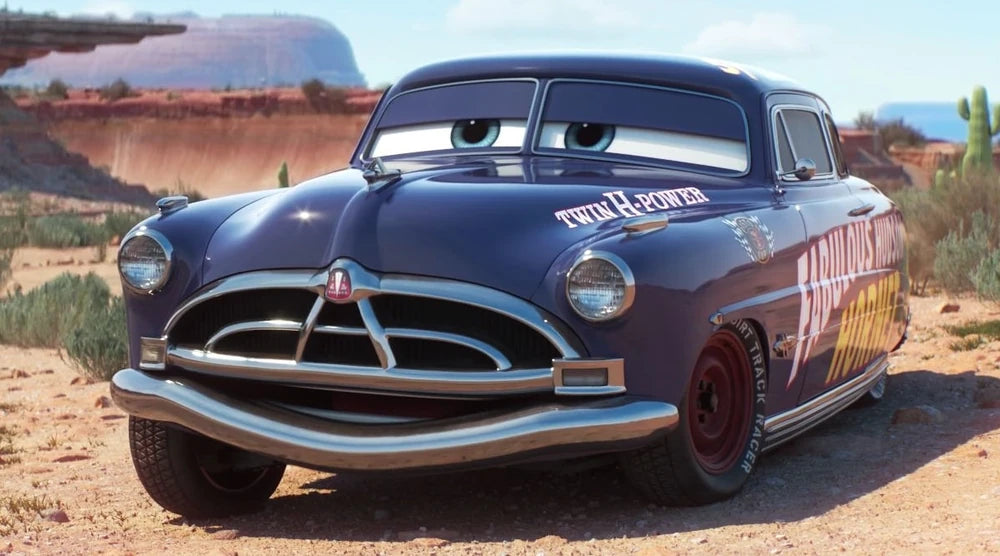
The Secrets of Doc Hudson: An Automotive Odyssey
1652 words | Reading time: 9 minutes
Behind the scenesDoc HudsonHudson Hornet
Almost everything that defines Doc Hudson really existed. The Hudson Hornet, a sedan produced from 1951 onwards, hid a “step-down” floor and a 308-cubic-inch six-cylinder engine: enough to claim 78 NASCAR wins in 149 races between 1951 and 1954, in the hands of Marshall Teague and Herb Thomas. Its chief mechanic Smokey Yunick inspired the Smokey of Cars 3, and Paul Newman, Doc's original voice, finished second at the 1979 24 Hours of Le Mans. This article explores the true story behind the character, from the number 51 to countersteering in a drift.
Summary
- Doc Hudson (almost) existed
- The real Hudson Hornet (1951-1954)
- The "Fabulous Hudson Hornet" on the track
- Smokey Yunick, the real mechanic of the legend
- Paul Newman, a driver behind the microphone
- Hidden Easter eggs in the movies
- Summary table
- FAQ
- Sources
Doc Hudson (almost) existed
Doc Hudson's best-kept secret isn't his past as a champion: it's that his story is largely inspired by real events. The car, the nickname "Fabulous Hudson Hornet," the domination of the racetracks in the early 1950s, and even the chief mechanic — all existed in the history of American racing.
This article explores the true story behind the character. For Doc's full portrayal in the movies (his role as a mentor, his lessons, his legacy), read our feature Doc Hudson, the legendary mentor from Cars who left his mark on a generation.

The legend in your pocket
Cars Doc Hudson Keychain
Doc Hudson accompanies you as a keychain: the Fabulous Hudson Hornet now watches over your keys.

The real Hudson Hornet (1951-1954)

The Hudson Hornet is a sedan produced by the Hudson Motor Car Company starting in 1951. On paper, it was nothing like a racing beast: an inline six-cylinder with side valves. And yet, it hid two revolutionary assets:
🏠 The Hornet's first asset played out right down at ground level: a lowered "step-down" floor between the frame rails. At the foot of your bed, that same low line comes back with our Cars rugs.
- the "step-down" design: a lowered floor between the frame rails, which lowers the center of gravity and keeps the car glued to the road — a rarity at the time;
- a 308 cubic inch (5.0 L) engine, the largest six-cylinder on the market, available with the famous "Twin H-Power" with dual carburetors.
This recipe — low chassis, exceptional road holding, high torque — turned this family sedan into a formidable racing machine.
The "Fabulous Hudson Hornet" on the track
The nickname painted on Doc's flanks actually graced real race cars. Two drivers made it famous:
- Marshall Teague — in 1951, he showed up unannounced at Hudson's headquarters in Detroit and convinced the brand to support him. A good call: he won 5 of his 15 NASCAR races that season, then the 1952 and 1954 AAA titles behind the wheel of his "Fabulous Hudson Hornet";
- Herb Thomas — NASCAR Grand National champion in 1951 and 1953 (the first two-time champion in the discipline's history), with 12 victories in the 1953 season alone.
In total, the Hudson Hornet secured 78 NASCAR victories out of 149 races between 1951 and 1954 — a dominance few cars have matched since. Like Doc, the real Hornet reigned from 1951 to 1953… before the evolution of the sport pushed it out.
📘 Another Cars 3 legend inspired by real racing history: Junior "Midnight" Moon.

Smokey Yunick, the real mechanic of the legend
Marshall Teague's chief mechanic was named Smokey Yunick, one of the most brilliant (and cunning) mechanics in NASCAR history. He was the one who transformed this large sedan into a winning machine.
Does his name ring a bell? It's the direct homage behind Smokey, Lightning McQueen's mentor in Cars 3 — the old Hudson pickup truck who knew Doc in his prime. The circle is complete.

Paul Newman, a driver behind the microphone
Pixar didn't choose Paul Newman to voice Doc in the original version by chance: the Hollywood star was also an authentic race car driver, runner-up in the 1979 24 Hours of Le Mans and a multiple SCCA national champion. No one was more legitimate to portray a retired champion.
Cars (2006) was one of his last film roles. After his death in 2008, Pixar removed the character from Cars 2 out of respect, then Cars 3 paid tribute to him by using archival recordings of Newman for Doc's flashbacks.
🔢 Doc's 51 shows up again on Cruz Ramirez's bodywork, in Dinoco colors: our Cars Mini Racers bring those racing numbers down to your scale, lined up on the corner of your desk.

Hidden Easter eggs in the movies
- The number 51 — Doc's race number is often interpreted as a reference to 1951, the year the Hudson Hornet was launched;
- Cruz's number 51 — in Cars 3, Cruz Ramirez races under number 51 in Dinoco colors, as a direct tribute to Doc;
- "Turn right to go left" — the technique Doc teaches Lightning is a real dirt track driving maneuver (counter-steering in a drift), commonly used on the dirt ovals of the 1950s.

Summary table
| Element | Verified data |
|---|---|
| Real car | Hudson Hornet, produced from 1951 |
| Technical assets | "Step-down" design (low center of gravity), 308 ci (5.0 L) 6-cyl., Twin H-Power option |
| Drivers of the "Fabulous Hudson Hornet" | Marshall Teague and Herb Thomas |
| Real achievements | 78 NASCAR victories out of 149 races (1951-1954); NASCAR titles 1951 and 1953 (Thomas), AAA titles 1952 and 1954 (Teague) |
| Chief mechanic | Smokey Yunick — who inspired Smokey in Cars 3 |
| Doc's original voice | Paul Newman, himself a driver (2nd at Le Mans 1979) |
| Doc's number | 51, often interpreted as a reference to 1951 |
FAQ — Frequently asked questions
-
Did Doc Hudson really exist?The character is fictional, but almost everything that defines him is real: the Hudson Hornet, the nickname "Fabulous Hudson Hornet," the NASCAR dominance from 1951-1953, and even the mechanic Smokey.
-
Who was the real "Fabulous Hudson Hornet"?Two drivers bore this nickname on their cars: Marshall Teague (AAA titles 1952 and 1954) and Herb Thomas (NASCAR champion 1951 and 1953).
-
Why does Doc wear number 51?Most often, it is seen as a reference to 1951, the year the Hudson Hornet was launched. Cars 3 uses this number for Cruz Ramirez as a tribute to Doc.
-
Did the Smokey from Cars 3 exist?He is inspired by Smokey Yunick, Marshall Teague's chief mechanic and a legendary figure in the NASCAR paddocks of the 1950s-1960s.
-
Is the "turn right to go left" technique real?Yes, it is the counter-steering drift used on dirt ovals, very common in American racing in the 1950s.
Sources
- Wikipedia — Fabulous Hudson Hornet
- Motor Sport Magazine — Marshall Teague and the Fabulous Hudson Hornet
- NASCAR Hall of Fame — The Fabulous Career of Herb Thomas

Tribute to the Hornet
Cars Doc Hudson Hornet Bob Hat
This Doc Hudson Hornet bob hat smells like the dirt tracks of the 50s — the official headwear for connoisseurs.
🧦 The Doc Hudson Hornet bob hat smells like the dirt tracks of the 50s; at the other end of the outfit, our Cars socks take you all the way into your sneakers.
↑ Back to top